Processing services – Professional, high-precision steel and metal processing
With our modern machinery, we process the products precisely according to your wishes.
Sawing and cutting
We cut steel and metal precisely to length, in Europe's most high-tech cutting and sawing centre.
Learn moreTube laser cutting
Thanks to laser technology, we are able to saw, drill, mill and deburr steel and metal in a single process step.
Learn moreFriction drilling
Using modern equipment, we realise chipless passages in thin-walled profiles.
Learn moreEdge and surface finishing
We deliver metal blanks deburred and free of rust, scale and rolling skin. If required, we can also provide blanks preserved, lasered or barrel finished.
Learn moreWhat is cast iron used for?
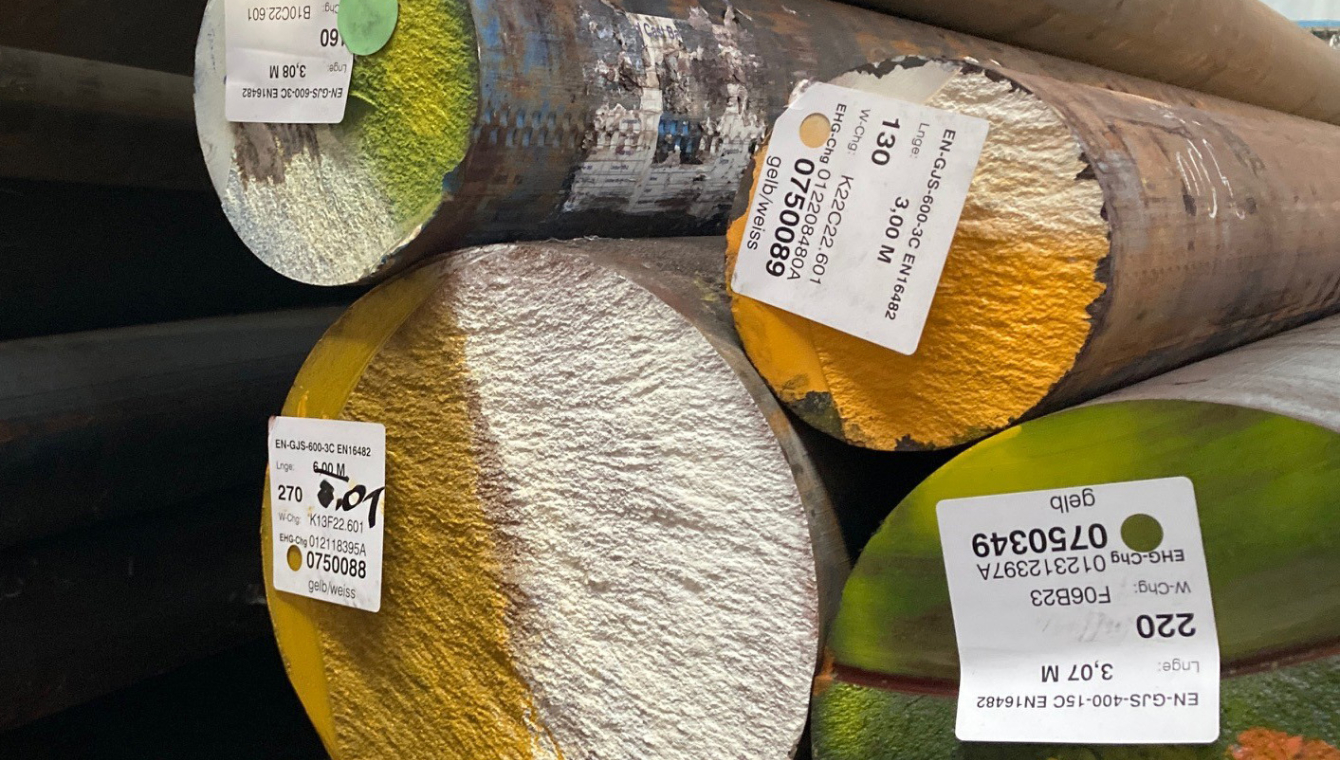
Cast iron has become an indispensable material in today's economy. It is hard to find any industry that doesn't use cast components manufactured from a grade of cast iron. The possible applications are extremely diverse and vary depending on the grade of cast iron:
- Grey cast iron is particularly cheap to produce and is therefore the most commonly used material in cast iron production. It is versatile and is used in such areas as the production of gearboxes and crankcases, brake discs, machine tool construction and for the production of pumps and valves in mould casting.
- Ductile cast iron is used in numerous industrial areas, such producing water or gas pipes by means of the centrifugal casting method. Ductile cast iron is very important in the automotive industry, where it has replaced the use of cast steel or forged steel for the production of vehicle parts including crankshafts, camshafts and wheel hubs.
- Malleable cast iron is used in the automotive industry, for parts including connecting rods, steering columns and gearshift forks. However, it is also used in elements for high-voltage and overhead lines, as well as in installation technology.

What are the properties of cast iron?
All cast iron grades exhibit the following basic properties due to their high carbon content (2.2-3.6%):
- Excellent flow properties
- Good machinability
- High damping properties
- Low elasticity
Different mechanical properties result depending on the structure, i.e. the shape of the graphite particles in the base mass.
Cast iron with lamellar graphite (grey cast iron)
In grey cast iron, the graphite is formed as thin irregularly shaped rods. These lamellae act as notches under tensile load, meaning that the tensile strength is low. At the same time, the notch effect ensures that components made of this material are insensitive to external notches caused by the design. Furthermore, this cast iron grade is characterised by high compressive strength and wear resistance, as well as good damping properties. Grey cast iron with lamellar graphite also conducts heat, while cast iron parts with an intact cast skin additionally possess good corrosion resistance.
Cast iron with nodular graphite (spheroidal graphite cast iron)
The graphite in spheroidal graphite cast iron is in a spherical form. There are fewer interruptions in the metallic base mass due to the graphite balls, which eliminates the internal notch effect. This increases the strength and the cast iron element achieves a high ductility. The material obtains similar mechanical properties to unalloyed steel, but remains well-suited to casting.
Malleable cast iron
All the carbon in this cast iron grade (with low silicon content) is bound in the iron, resulting in a graphite-free hard, brittle cast iron that becomes malleable. It is only the heat treatment (annealing) that causes a structural transformation and gives the malleable cast iron its final properties. When fully decarburised, it is referred to as white malleable cast iron (white cast iron). Incomplete decarburisation results in black malleable cast iron (black casting).
Malleable cast iron is forgeable, tough, readily formable, weldable and corrosion-resistant. Black cast iron is easier to machine than white cast iron.
What is cast iron made of?
Cast iron consists of an iron alloy with a high proportion of carbon (> 2%) and silicon (> 1.5%) as well as other alloying components such as manganese, chromium or nickel.
How is cast iron processed?
Cast iron is highly suited to casting but exhibits poor formability. This means it is difficult to bend or roll. Forming therefore largely takes place by means of casting processes such as mould casting, ingot casting and continuous casting.
What is continuous casting?
Continuous casting is a casting process for the production of high-quality semi-finished products fabricated from cast iron, steel or non-ferrous metals. In contrast to ingot casting, continuous casting is a semi-continuous to continuous process in which the metal is poured through a cooled, bottomless and reusable mould (ingot mould or chill mould). Inside the mould, the strand shell solidifies and is usually withdrawn in the direction of casting while the core is still liquid. The strand shell is drawn forwards in stages on roller conveyors and continuously cooled with spray water until the strand fully solidifies. It is then cut to the desired length.
The continuous casting technique is very similar when processing steel, copper alloys or aluminium. It differs mainly in terms of temperature, which can reach over 1600°C in the case of steel.
Continuous cast products are further processed in the steel and metal industry into the respective end product, for example by rolling, pressing or deep drawing, or through thermal treatments such as tempering or ageing.
Visit our online shop!
Visit our online shop to find all the information you need on availability, dimensions and delivery conditions. Once you have registered, you will have constant access to the latest prices and you can purchase your steels and non-ferrous metals directly online.
Continue to shopDo you have any questions?
Are you looking for a specific quality or processing service, or are you interested in our services? Contact us today. We deliver solutions.